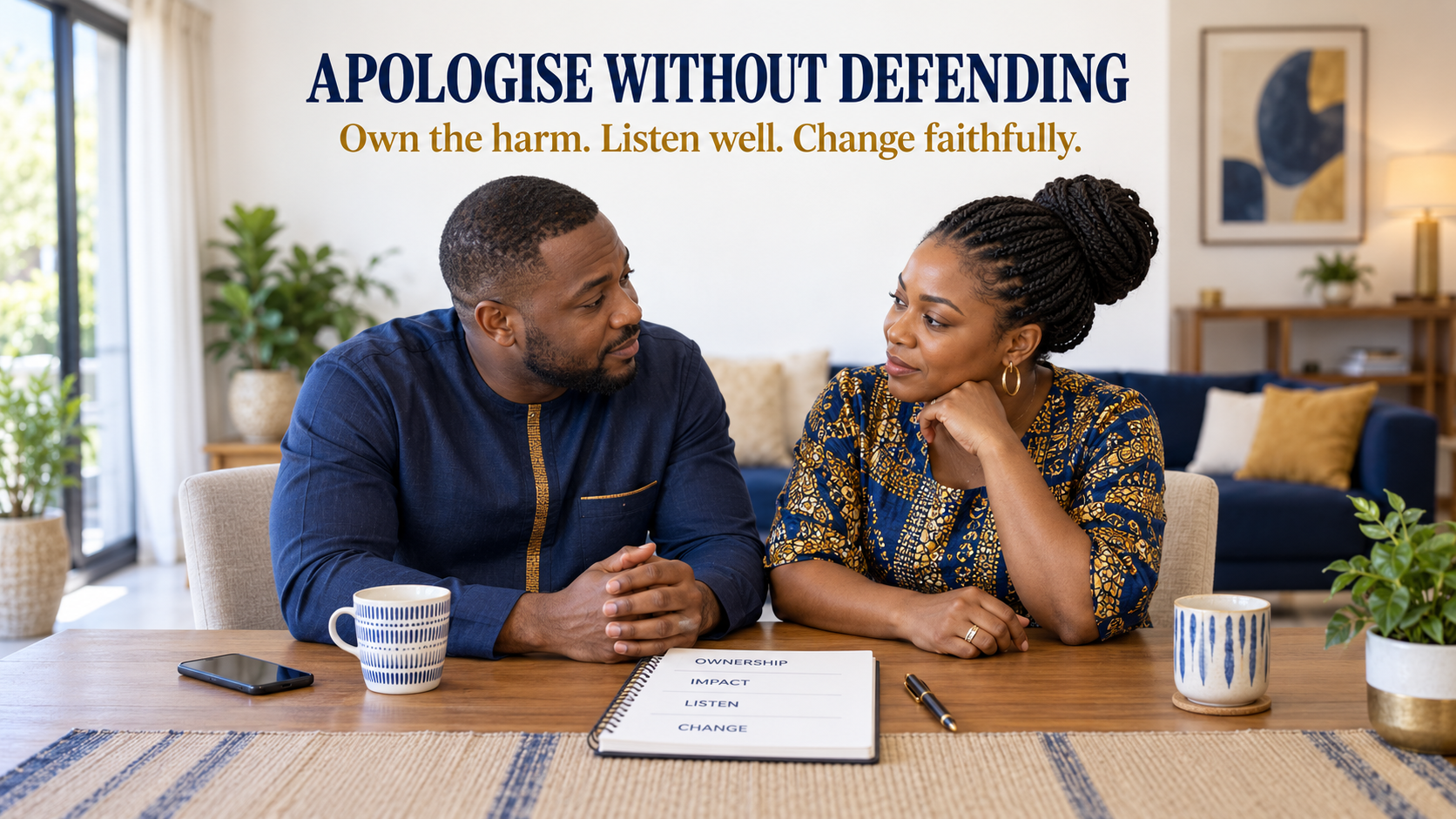
How to Apologise to Your Spouse Without Defending Yourself
A practical Christian framework for owning harm, listening without defensiveness and rebuilding trust through faithful change.
Learning how to apologise to your spouse without defending yourself is one of the most practical ways to protect trust after a painful conversation. Many apologies fail because they contain an explanation, correction or counter-accusation before the injured person has felt heard. The words “I am sorry” are spoken, but responsibility is quietly withdrawn.
A healthy apology does not require you to accept a false version of events. It asks you to take honest responsibility for the part that belongs to you. That may include your words, tone, timing, withdrawal, exaggeration or failure to listen. When ownership becomes clear, repair can begin.
This article offers general relationship and pastoral education. It does not replace qualified counselling, safeguarding support or professional help where there is abuse, coercion, violence or serious danger.
Why It Can Be Difficult to Apologise to Your Spouse
An apology can feel threatening when you believe that accepting responsibility means losing the argument. You may fear that your spouse will use the admission against you, ignore their own contribution or interpret your humility as proof that every accusation was correct.
Defensiveness often appears as self-protection. It may sound like, “I only said that because you started it,” “You misunderstood me,” or “I am sorry, but you also hurt me.” These statements may contain information worth discussing later. Yet when they are attached to the apology, they shift attention away from the harm you caused.
A mature apology separates two conversations. The first addresses your responsibility. The second, when both people are ready, addresses the wider disagreement and your spouse’s responsibility. Keeping those conversations separate prevents accountability from becoming a negotiation.
“He who covers his sins will not prosper, But whoever confesses and forsakes them will have mercy.”
Proverbs 28:13 (NKJV)
A Real Apology Names the Harm Clearly
Vague language makes repair difficult. “Sorry for everything” may sound humble, but it leaves your spouse unsure whether you understand what happened. A meaningful apology identifies the behaviour and its likely effect.
Instead of saying, “I am sorry you felt hurt,” say, “I interrupted you repeatedly and dismissed what you were trying to explain. That was disrespectful, and I understand why it hurt.” The first sentence places the problem inside your spouse’s feelings. The second takes ownership of your conduct.
Accuracy matters. Do not exaggerate your wrongdoing to appear dramatic, and do not minimise it to protect your image. State what you did, acknowledge the effect and leave room for your spouse to describe anything you have missed.
How to Apologise to Your Spouse Without Adding a But
The word “but” often cancels everything before it. “I am sorry I shouted, but you were not listening” turns an apology into an accusation. A better sentence ends after the ownership: “I raised my voice. That was wrong. I am sorry.”
You can discuss the original issue later. Removing the defence does not mean the issue disappears. It means you refuse to use your spouse’s conduct to excuse your own.
If you feel too activated to speak responsibly, ask for a brief pause and name when you will return. A pause becomes avoidance when it has no return point. It becomes wisdom when it protects the conversation and is followed by faithful action.
Use a five-part apology
A useful apology includes five parts: name the action, acknowledge the effect, accept responsibility, express sincere regret and state the change you intend to make. For example: “I spoke about a private matter in front of other people. That embarrassed you and weakened your trust. I should not have done it. I am sorry. I will protect our private conversations and ask before sharing personal information.”
Listen Before You Explain
When you apologise to your spouse, your task is not only to deliver a prepared statement. You also need to listen. Your spouse may explain an effect you did not anticipate. Resist the urge to correct every detail immediately.
Listening does not require agreement with every interpretation. You can say, “I did not realise that my words affected you that deeply, but I want to understand.” This response recognises the experience without pretending that you already see everything the same way.
Reflect back what you heard: “You felt dismissed because I checked my phone while you were speaking.” This gives your spouse an opportunity to confirm or clarify. Understanding should come before problem-solving.
“Confess your trespasses to one another, and pray for one another, that you may be healed.”
James 5:16 (NKJV)
Do Not Demand Immediate Forgiveness
An apology is an act of responsibility, not a tool for controlling the other person’s response. Your spouse may need time to process what happened. Pressuring them to say “I forgive you” can turn your apology into another demand.
Forgiveness and restored trust are related but not identical. Forgiveness releases vengeance and bitterness before God. Trust is rebuilt through truthful, consistent behaviour. Serious or repeated harm may require clear boundaries, counselling and a longer period of demonstrated change.
You can ask, “Is there anything you need from me while we work through this?” Then listen carefully. Do not promise what you cannot sustain.
Let Repentance Become Visible Change
To apologise to your spouse faithfully, connect your words to a specific change. If the problem was harsh speech, agree on a pause signal. If it was broken confidentiality, define what will remain private. If it was an unkept commitment, record the responsibility and deadline.
Change should address the pattern, not only the incident. Ask what conditions made the failure more likely. Were you tired, rushed, embarrassed, distracted or unwilling to admit uncertainty? Understanding the pattern helps you build a practical safeguard.
Do not make your spouse responsible for supervising your repentance. Invite accountability, but take ownership of the reminder, structure and follow-through.
“Let no corrupt word proceed out of your mouth, but what is good for necessary edification, that it may impart grace to the hearers.”
Ephesians 4:29 (NKJV)
What a Christian Apology Does and Does Not Mean
A Christian apology reflects confession, humility and reconciliation. Jesus treated reconciliation as important enough to interrupt religious activity. Faithfulness to God cannot be separated from the way believers address harm in relationships.
However, humility does not mean accepting abuse, manipulation or false guilt. If an interaction is unsafe, seek appropriate help. Reconciliation requires truth, responsibility and safety; it should not be forced through spiritual pressure.
Where both spouses have contributed to the conflict, each person should own their part without making the other person’s confession a condition for their own. Mutual repair becomes possible when responsibility is offered freely rather than traded.
“First be reconciled to your brother, and then come and offer your gift.”
Matthew 5:23–24 (NKJV)
A Short Conversation Framework for Marriage Repair
Use this sequence when the situation is calm enough for a responsible conversation:
- Ownership: What exactly did I say or do?
- Impact: How did it affect my spouse or the relationship?
- Regret: Can I express sorrow without qualification?
- Listening: What does my spouse need me to understand?
- Change: What specific action will demonstrate repentance?
- Review: When will we check whether the change is working?
Keep the conversation focused. Do not reopen ten previous disagreements. If the wider issue still needs attention, schedule another conversation after the immediate repair has been addressed.
When an Apology Is Not Enough
Some situations require more than a private conversation. Repeated betrayal, intimidation, financial secrecy, coercive control, violence or severe breakdown should not be treated as a simple communication problem. Appropriate pastoral, professional, legal or safeguarding support may be necessary.
Counselling can also help when the same argument returns despite sincere effort, when one or both spouses shut down, or when trust has weakened so deeply that conversations no longer feel productive. Seeking help is not failure. It can be a responsible step toward clarity and safety.
Choose Responsibility Over Self-Protection
Learning to apologise to your spouse is not about performing perfect words. It is about choosing truth over image management and repair over self-protection.
Name what you did. Acknowledge the effect. Remove the defence. Listen without rushing. Accept that trust may need time. Then make repentance visible through consistent change.
A sincere apology cannot control the whole outcome, but it can create an honest opening. Used with humility, wisdom and follow-through, that opening can help a marriage move from injury toward understanding and renewed trust.
A Practical Marriage Conflict Resource
Marriage Conflict Resolution Guide supports couples seeking practical tools for communication, emotional control, conflict resolution and restored unity.
Continue Your Marriage Growth Journey
Take One Honest Step Toward Repair
Begin by naming the part that belongs to you. Listen carefully, remove the defensive “but” and choose one visible change that protects trust.
Use the Marriage Health Assessment and Conflict Clarity Guide


