Faith-Based Personal Growth
How to Stop Comparing Your Progress and Trust God's Timing
Stop measuring your life by another person’s season. Learn to review your own progress, prepare faithfully and move forward with peace.
To trust God's timing is not to pretend that delay never hurts. It is to refuse to measure your worth, calling or progress by somebody else's visible season. Comparison can turn another person's good news into evidence against your own life. A promotion, marriage, business milestone, ministry opportunity or academic achievement may suddenly make your faithful work feel small. Yet a different timeline does not mean a forgotten life.
The pressure is especially strong online, where people usually share outcomes rather than the years of uncertainty, support, failure and ordinary discipline behind them. You may compare your private process with someone else's public result. That comparison is incomplete before it begins.
Christian growth invites a better question. Instead of asking, ‘Why am I not where they are?’ ask, ‘What has God entrusted to me in this season, and what is my next faithful step?’ This change does not remove ambition. It directs ambition toward stewardship rather than rivalry.
Why Comparison Distorts the Meaning of Progress
Comparison borrows another person's measurements and uses them to judge your life. It assumes that the same outcome should happen for everyone at the same age, speed or scale. But people begin with different responsibilities, resources, relationships, opportunities and assignments.
A person caring for family members may move more slowly in formal study. An entrepreneur rebuilding after a failed venture may need a quieter season of learning. A ministry worker may be developing character long before receiving a larger platform. Slower visible progress can still contain real obedience, skill and maturity.
Comparison also narrows attention. It makes you notice what is absent while ignoring what has already grown. You may overlook improved discipline, deeper prayer, healthier boundaries, stronger competence or greater courage because those gains do not look dramatic beside someone else's announcement.
“But let each one examine his own work, and then he will have rejoicing in himself alone, and not in another. For each one shall bear his own load.”
What Does It Mean to Trust God's Timing?
To trust God’s timing means placing your season in God’s hands while continuing to obey, learn, prepare and act wisely. It is active faith, not passive waiting.
To trust God's timing means placing your season in God's hands while continuing to obey, learn, prepare and act wisely. It is active faith, not passive waiting. You stop demanding that your life copy another person's schedule, but you do not stop doing the work that faithfulness requires.
Psalm 31:15 begins, ‘My times are in Your hand.’ David's words do not describe a comfortable life without pressure. They express confidence in God while danger remains real. Biblical trust can therefore coexist with honest questions, planning and responsible action.
“My times are in Your hand; Deliver me from the hand of my enemies, And from those who persecute me.”
Trust God's Timing Without Becoming Passive
Waiting becomes unhealthy when it is used to avoid a decision, conversation or discipline that is already clear. You can pray about a career while updating your skills. You can trust God with a business while testing the offer and listening to customers. You can hope for a relationship while becoming more honest, mature and able to communicate.
Faithful waiting has movement inside it. There may be no public breakthrough yet, but there can be preparation, repentance, practice, service and wise counsel. These are not consolation prizes. They are part of becoming ready to carry what you are asking for.
Use a simple test: if the desired opportunity arrived today, what capacity would it require? Then work on that capacity. Improve the skill. Repair the neglected system. Learn to manage the smaller responsibility. Practise the conversation. Complete the application. Your responsibility is not to control every outcome; it is to be faithful with the work available now.
Measure Faithfulness Instead of Borrowed Timelines
A healthier progress review begins with evidence from your own assignment. Choose measures that reflect what you can responsibly influence. These may include hours of focused practice, applications submitted, conversations held, customers served, money stewarded, lessons completed, habits kept or relationships repaired.
This is not an attempt to earn God's love through productivity. It is a way to see whether your intentions are becoming action. Outcomes matter, but they are not the only evidence of growth. Faithfulness asks whether you used what you had truthfully and responsibly.
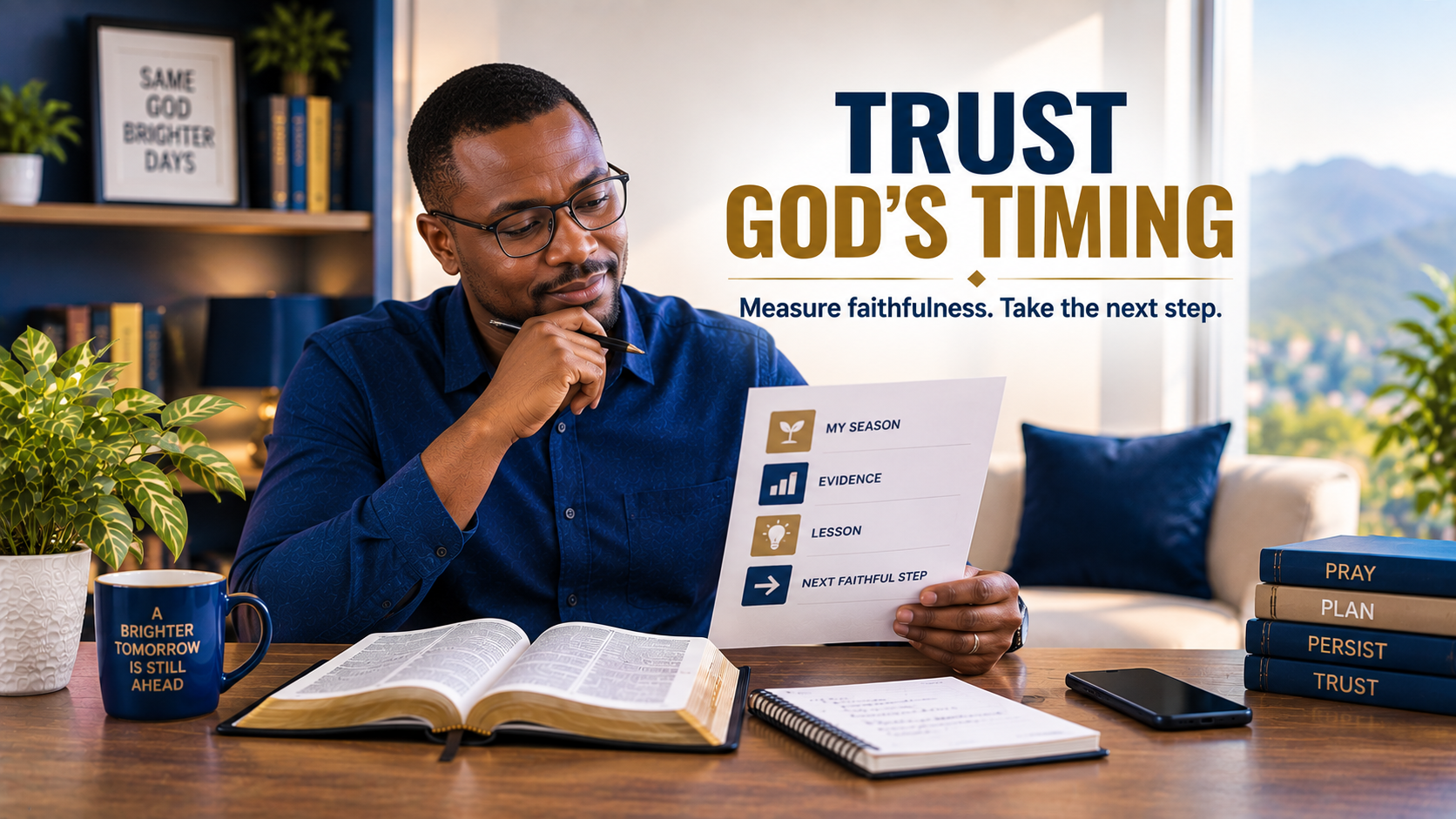
Once a week, record three things: what moved forward, what the evidence taught you and what you will do next. This creates a truthful record that protects you from the feeling that ‘nothing is happening.’ If the evidence shows that an approach is not working, you can adjust it without calling yourself a failure.
A personal progress review
Ask these five questions:
- What responsibility did God place in front of me this week?
- What did I complete or learn?
- Where did I avoid necessary action?
- What support, skill or correction do I need?
- What is one faithful step for the next seven days?
The purpose is not to create a new instrument of self-criticism. It is to replace vague comparison with honest stewardship.
Learn From Other People Without Competing With Them
Other people's progress can become information rather than condemnation. Ask what their example teaches. Perhaps their consistency shows the value of repetition. Their career move may reveal a skill you need. Their healthy marriage may expose the importance of communication and counsel. Their business may demonstrate that a clear problem and dependable service matter more than appearances.
Learning is different from imitation. You can adopt a principle without copying a calling. You can celebrate another person's result while choosing a path suited to your responsibilities and convictions.
When envy appears, name it honestly before God. Then practise gratitude and blessing. Gratitude restores attention to grace already present in your life. Blessing another person breaks the assumption that their progress has reduced what is possible for you.
When You Trust God's Timing, Delay Can Still Require Adjustment
Not every delay should be spiritualised. Sometimes progress is slow because the plan is unclear, the skill is weak, the market has changed, the relationship needs an honest conversation or the chosen method is ineffective. Trust does not forbid evaluation.
Review the evidence without shame. Ask a trusted person for feedback. Identify the assumption behind your approach. Run a smaller test. Set a real deadline. If the evidence repeatedly shows that a path is unwise or unavailable, changing direction can be stewardship rather than defeat.
The key is to separate identity from method. A failed method is not a failed person. A closed door is not proof that God has abandoned you. You may need to wait, prepare, revise or release. Wisdom asks which response fits the evidence and biblical values.
Protect Your Attention From Comparison Triggers
If certain online accounts repeatedly leave you resentful, panicked or ashamed, reduce your exposure for a time. This is not hostility toward the people involved. It is responsible attention management. Replace impulsive scrolling with a defined window for learning, prayer, reading or focused work.
Also be careful with conversations that reduce every life to age-based milestones. A deadline can help when it governs a real commitment. It becomes harmful when it turns a cultural expectation into a verdict on human worth.
Build relationships where people can discuss both achievement and process. Honest community reminds you that most meaningful growth includes waiting, correction and unseen work. If comparison is producing persistent distress, damaging daily functioning or deep hopelessness, seek appropriate pastoral and qualified professional support. This article offers general encouragement, not mental-health diagnosis or treatment.
Trust God's Timing and Keep Doing the Next Faithful Thing
Philippians 1:6 directs confidence toward God, who begins and completes His work. That promise does not give us a timetable for every personal desire. It does give believers reason to reject the idea that an unfinished process is automatically an abandoned process.
“being confident of this very thing, that He who has begun a good work in you will complete it until the day of Jesus Christ;”
A Seven-Day Practice to Trust God's Timing
For the next seven days, begin each morning with one sentence: ‘My times are in God's hands, and my responsibility is today's faithful step.’ Then write one action that is small enough to complete and meaningful enough to matter.
At the end of each day, record evidence rather than mood alone. Did you make the call, complete the lesson, submit the work, keep the boundary, pray, rest responsibly or ask for help? Small completed actions rebuild agency. They also reveal where a larger plan needs support.
At the end of the week, review the record. Celebrate grace. Correct what needs correction. Choose the next step. You do not need to force somebody else's season onto your life to prove that you are growing.
Conclusion: Your Pace Is Not Your Identity
You can trust God's timing without denying disappointment. You can admire another person's progress without turning it into a sentence against yourself. You can wait without becoming passive and act without trying to control everything.
Examine your own work. Measure faithfulness. Learn from evidence. Receive correction. Protect your attention. Keep preparing for the responsibilities you hope to carry.
Your life is not valuable because it is moving faster than someone else's. In Christ, your identity is received, not ranked. Let that security free you to work diligently, celebrate others sincerely and take the next faithful step with peace.
A Resource for Growing Without Comparison
Becoming Your Best Self in Christ: A Biblical Guide to Thriving in Every Area of Life
This catalogue-verified resource is relevant to readers who want to grow spiritually, emotionally, mentally and practically through Christ without turning growth into competition.
Continue Your Freedom Hub Growth Journey
Choose the pathway that best supports your next faithful step:
Take the Next Faithful Step
Do not wait for comparison to disappear before you act. Choose one responsibility you can honour today, complete it with care and record what the evidence teaches you.
Continue with practical teaching in the Freedom Hub Knowledge Centre.