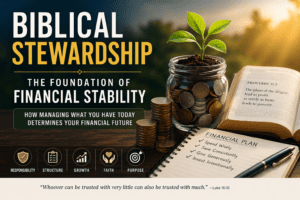
Stewardship Over Ownership: Rethinking Money Biblically
A calm, biblical guide to financial order, spiritual alignment, and disciplined stewardship for believers, families, professionals, and entrepreneurs seeking long-term clarity under God.
Money often reveals more than spending habits. It reveals formation, priorities, and whether life is being ordered under God. This article reframes financial thinking through the lens of biblical stewardship, helping readers move from pressure and reaction into clarity, discipline, and faithful responsibility.
Article Navigation
1.Introduction — Naming the Quiet Financial Tension
Many sincere believers carry a quiet financial tension that is rarely spoken about openly. They desire to honor God with their lives, yet their financial decisions often feel reactive rather than intentional. Money becomes a source of pressure, identity, comparison, or anxiety rather than a tool of stewardship.
This tension is not primarily about income levels or economic conditions. It is about perspective. When money becomes tied to identity, security, or status, financial decisions begin to drift away from spiritual alignment.
The biblical vision offers a different framework — one that restores clarity and calm responsibility. Scripture does not treat money as personal ownership in the ultimate sense, but as entrusted stewardship. What we manage ultimately belongs to God.
This is why biblical financial stewardship requires a shift in thinking. The issue is not merely how much we have, but how faithfully we manage what has been entrusted.
Readers who desire a broader foundation for this conversation may explore the Faith-Based Financial Literacy pillar for biblical money wisdom.
And for those beginning a broader journey toward ordered Christian living, the Freedom Hub start here guide for spiritual clarity and practical direction provides a strong next step.
2.The Biblical Vision of Financial Stewardship
Scripture consistently frames money within the language of stewardship, faithfulness, and wisdom rather than accumulation or personal possession.
Financial stewardship is therefore a testing ground of character. Faithfulness in small matters reveals whether a person can be trusted with greater responsibility.
Biblical stewardship favors thoughtful planning rather than impulsive financial decisions. Financial order rarely emerges accidentally; it grows through disciplined foresight.
Money itself is not condemned. The distortion occurs when it becomes a source of identity or devotion.
This principle encourages diversification, prudence, and preparedness.
Stewardship reflects the inner posture of the heart toward God’s provision.
3.Where Many Believers Drift Financially
Financial misalignment among believers rarely begins with rebellion. It often begins with subtle drift.
Several patterns commonly appear:
- reacting financially rather than planning
- allowing lifestyle expansion to outpace income growth
- equating financial success with personal worth
- avoiding honest financial reflection
- operating without counsel or accountability
When these patterns remain unexamined, financial life becomes increasingly unstable.
Two companion guides explore these dynamics in greater depth and offer formative correction:
Break poor financial habits through godly stewardship formation
Learn why money must remain a tool and never become your identity
These resources are not meant to create shame or guilt. Their purpose is clarity.
Stewardship begins with honest awareness. The goal is not perfection but alignment.
4.The Practices That Build Financial Stability
Biblical financial stability grows through disciplined habits rather than sudden breakthroughs. Formation develops through repeated faithful practices.
1. Planning Before Spending
Scripture affirms deliberate planning as a mark of wisdom. Intentional planning brings order to financial decisions and prevents reactive choices. Planning restores stewardship authority.
2. Creating Financial Margin
Margin provides breathing space for wise decisions. When every resource is immediately consumed, stewardship becomes strained. Margin protects peace.
3. Disciplined Generosity
Giving is not merely charitable behavior; it is spiritual formation. Generosity breaks the illusion that money belongs to us. It reminds the heart that everything ultimately belongs to God.
4. Transparent Tracking
Financial stewardship requires awareness. Tracking income and expenses reveals patterns that would otherwise remain hidden. Clarity enables correction.
5. Seeking Wise Counsel
Proverbs repeatedly encourages counsel in decision-making. Financial isolation often leads to avoidable mistakes. Trusted counsel strengthens stewardship.
6. Patient Financial Growth
Scripture favors slow, stable growth rather than quick gain. Long-term thinking produces sustainable results.
7. Learning Stewardship Continuously
Financial wisdom grows over time. Readers seeking practical frameworks and structured guidance may explore the biblical money stewardship resource library for practical tools and guidance.
5.Financial Stewardship Across Life Contexts
Stewardship must extend beyond theory into everyday life decisions.
Household Leadership
Families benefit when financial decisions reflect unity, transparency, and shared vision. Financial clarity reduces conflict.
Business Decisions
Entrepreneurs and professionals must treat business resources as entrusted responsibility rather than personal entitlement. Integrity strengthens influence.
Income Management
Income is not merely spending capacity. It is stewardship responsibility. Wise allocation sustains stability.
Debt Caution
Debt is sometimes unavoidable but must always be approached cautiously. Unwise debt limits future stewardship freedom.
Giving
Biblical generosity acknowledges God as the ultimate source of provision. Giving keeps the heart aligned with eternity.
Future Preparation
Scripture encourages foresight and preparation. Responsible planning honors both family and calling. Stewardship thinks beyond the present moment.
6.Strengthening the Ordered Life Framework
Financial stewardship functions best when integrated into a broader framework of spiritual maturity.
Freedom Hub approaches financial wisdom through the Ordered Life framework, which emphasizes four foundational dimensions:
Alignment
Financial decisions reflect submission to God’s principles.
Discipline
Consistent habits sustain long-term stewardship.
Stewardship
Resources are managed responsibly rather than consumed impulsively.
Responsible Influence
Faithful stewardship creates stability that can serve others.
Readers seeking continued growth in this area may explore the full Faith-Based Financial Literacy pathway for deeper stewardship formation.
7.Conclusion — Calm Invitation to Ordered Growth
Biblical stewardship invites believers into a long-term journey rather than immediate transformation.
Financial order grows gradually through faithful decisions, honest reflection, and disciplined living. Progress often appears quietly. Yet over time, small acts of stewardship accumulate into significant stability.
Those seeking deeper personal guidance may explore the Christian life coaching services for personal clarity and ordered growth.
Readers interested in extended learning may also explore the financial wisdom books for biblical stewardship and money clarity.
Growth also becomes easier when pursued within supportive community through the Purpose, Stewardship and Growth community for ongoing formation.
An additional learning resource that explores practical financial wisdom in depth is available through Play Smart With Your Money for practical financial understanding.
Stewardship ultimately reflects trust. And trust grows through faithful practice.
For ongoing insights on ordered living, biblical stewardship, and responsible influence, readers are also welcome to follow the Freedom Hub WhatsApp Channel for regular faith-based stewardship insights.
Small decisions made faithfully over time build a stable life under God.
Continue Your Stewardship Formation
Growth in financial wisdom is strongest when it is guided, ordered, and sustained. Continue building clarity through these next steps:
- Read more within the Faith-Based Financial Literacy pillar
- Access biblical money stewardship resources and practical tools
- Seek personal guidance through Christian life coaching services
- Study deeper through Freedom Hub financial wisdom books
- Join the Freedom Hub WhatsApp Channel for ongoing encouragement and insight
8. Full Internal Linking Map
Use the following internal links within this article and related Freedom Hub content to strengthen topic authority, improve navigation, and guide readers into a more ordered pathway of growth.
Pillar Hub
Main authority page for the wider faith-based financial literacy cluster.
Faith-Based Financial Literacy pillar for biblical money wisdomStart Here Page
Best for readers who need a broader pathway into ordered Christian living and Freedom Hub’s formation framework.
Freedom Hub start here guide for spiritual clarity and practical directionRelated Article 1
Use where the article addresses hidden patterns, waste, inconsistency, or financial drift.
Break poor financial habits through godly stewardship formationRelated Article 2
Use where the article addresses identity, comparison, status, or emotional attachment to money.
Learn why money must remain a tool and never become your identityResource Library
Best for sections involving practical tools, worksheets, frameworks, and applied stewardship help.
Biblical money stewardship resource library for practical tools and guidanceLife Coaching Services
Use in conclusion or next-step sections for readers who need personal guidance and structured support.
Christian life coaching services for personal clarity and ordered growthBooks Page
Use for deeper study, extended reading, and long-form financial formation resources.
Financial wisdom books for biblical stewardship and money clarityCommunity Page
Use where the article encourages steady growth through shared learning, accountability, and encouragement.
Purpose, Stewardship and Growth community for ongoing formation